AR Test Design for Enhanced Placemaking Participation
The design of the test
Augmented Reality (AR) offers an innovative way to visualize complex ideas and environments, helping participants gain a deeper understanding of the living environment and proposed interventions. By overlaying digital elements onto real-world settings, AR makes it easier for people to see changes in context, fostering better involvement and active participation in urban development processes.
The ULL Trondheim team has designed three participation methods using AR during the street festival. These methods aim to make engagement inclusive and accessible, ensuring that everyone can interact with the content without technical barriers.
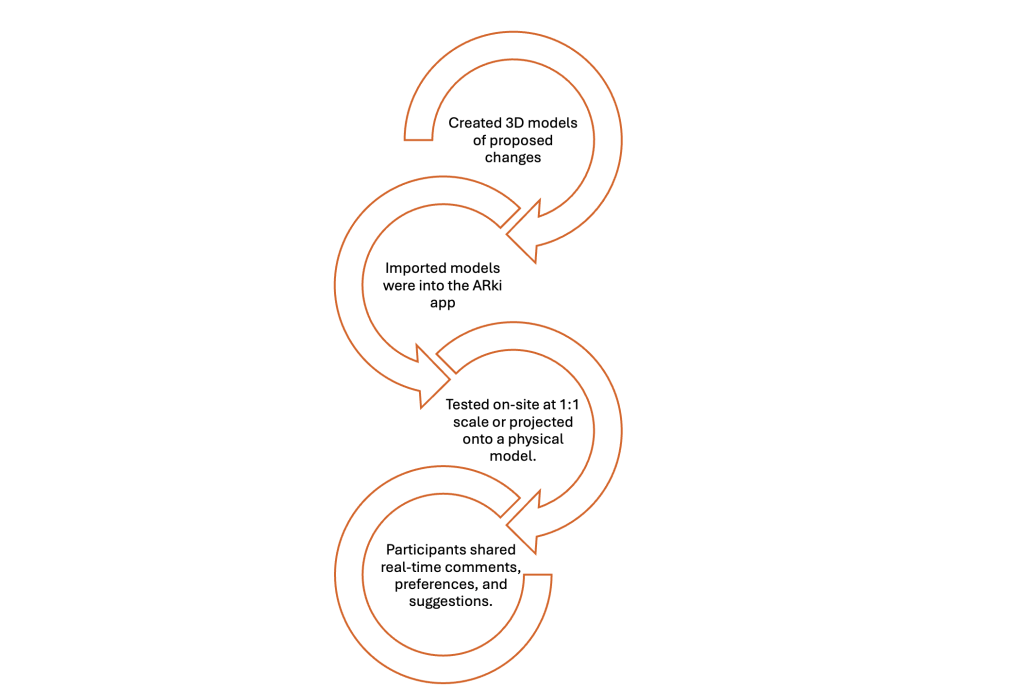
Three AR Test Scenarios
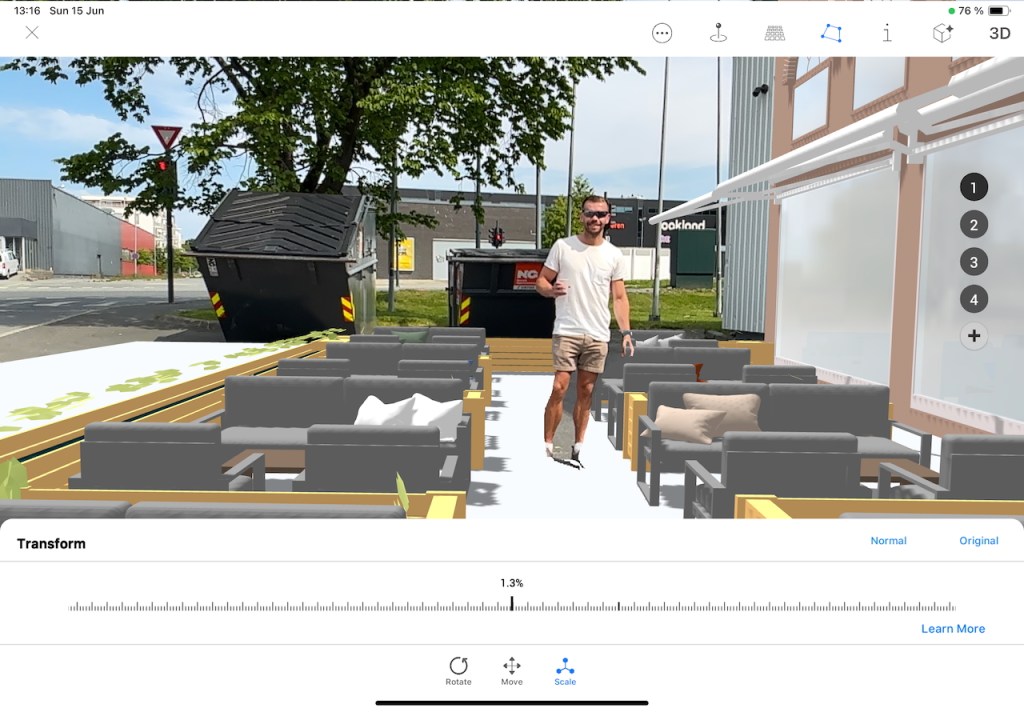
Immersive Co-Design of a Street Façade
The team selected a building façade along Haakon VII Street to explore its transformation into a vibrant street-front retail space, such as a café, restaurant, or shop, with extended outdoor seating and furniture. Several alternative façade designs were developed and embedded in AR. Participants experienced the changes in full scale at the site and provided feedback on:
- Design preferences
- Appropriateness for local character
- Perceived usability and attractiveness
This test helped assess both the placemaking potential and public acceptability of such intervention
Visual Presentation of Road Reconfiguration Alternatives
As County plans to reconfigure traffic lanes on Haakon VII Street, the team visualized two proposed alternatives using AR: Alternative A: Bus lane in the centre, car lanes on both sides, with a new roundabout in the middle. And Alternative B: Car lane in the centre, with bus lanes on either side.
The alternatives were overlaid onto a physical scale model, and participants were asked to compare the two options visually and then to vote for their preferred solution and explain their choices based on mobility, safety, and aesthetics
Co-Versioning Public Space on a Parking Lot
To tackle the lack of public space near Lade Arena, the team proposed repurposing a parking area into a multifunctional public zone. Four design concepts were developed as 3D models:
- A green city park
- A community garden
- A children’s playground
- A multi-use plaza with street shops
These alternatives were tested on the physical model, where participants could choose their favourite version; suggest changes or combinations and discuss how such transformations would serve community needs.
 ENACT 15 mC