
Envisioning Neighbourhoods and Co-Creating Thriving Communities in the 15-Minute City: ENACT 15mC
While transformation of currently car dominated areas to make them more walkable and attractive makes sense to many people, this is not universally accepted. Some will suffer loss, whether because driving becomes less attractive or that barrier walls become more open.
ENACT 15mC project, must engage people with all viewpoints on street design, including those who are often left out of participatory processes, to ensure all needs are understood and taken account of in co-creating change. Working with our industry partners, students and the local municipalities, we will engage with existing informal networks in the four living lab contexts alongside more formal recruitment strategies.
ENACT 15mC adopts a people centred approach to urban design.
ENACT 15mC will develop, contextualise and test methods for (re)distributing street space in favour of sustainable mobility options and the social dimension of streets and places. This will lead to new knowledge about walkable and attractive places in European contexts. Knowledge specific to each of the four consortium cities will be made available to policymakers, property owners and the public. Guidelines based on the experiences of all four living labs will be presented as guidelines on designing for walkability and active transport, urban co-creation processes and the use of technologies and other tools in public engagement.
ENACT 15mC project will therefore make a critical contribution to debates and understanding of the 15mC and its contribution to urban transitions for sustainable cities.
Enact 15mC Urban Living Labs (ULLs)
ENACT 15mC will (re)imagine urban public spaces and streets to make them more walkable, cyclable, and pleasant to spend time in. We will engage residents with diverse backgrounds and abilities; property owners and local municipalities in thematically distinct ULLs to co-create ideas for street and neighbourhood transformations. The living labs will address spatial and functional issues that currently challenge walkability in Trondheim, Gdansk, Valencia and Oxford. These cases each have different cultural, climatic and geographic contexts that design thinking must respond to. Iterative design processes through the living labs will be supported by novel Augmented and Virtual Reality technologies. While these tools are not uncommon, their use by the ENACT 15mC consortium will address critiques that they are functionalist in approach (versus design oriented), that they are manipulative and that they create barriers to involving people who are unfamiliar with or otherwise unable to use them. Visualising technologies will be made available to the public, along streets, in public spaces and during co-creation workshops. We aim to break down barriers with coaching and to compare use of these tools alongside others, including tactical urbanism, mapping and physical modelling. These comparisons will lead to new knowledge around co-creation processes.

People-centred 15mC
Planning Instruments for 15mC
Identity of 15mC
AR/VR Supported 15mC
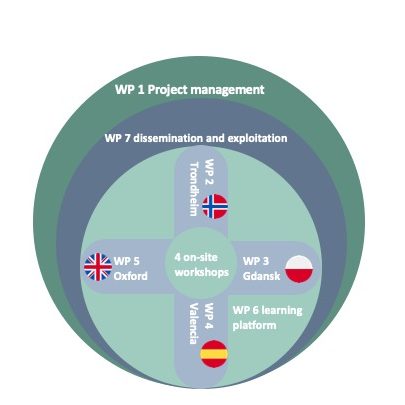
Work plan
ENACT 15mC will investigate the key factors and principles that underpin a co-creation process for urban transformation toward people-oriented public spaces that are inclusive, attractive, and sustainable. With this in mind, the proposed project work package structure is designed to support local activities within the four ULLs (WP2-5); a platform for cooperation between ULLs (WP6) that includes testing innovative ideas and sharing experiences (including AR tools)via four on-site workshops involving respective teams. All activities and cooperation between partners and ULLs are coordinated in WP1 by NTNU. The learning outcomes of ULLs will be disseminated at both national and international level in WP7.
 ENACT 15 mC