Diagnosis of historic centre
The first task consisted of carrying out a diagnosis of some of the most important aspects of urban life in the historic centre, such as: demographics, housing and tourist flats, and commerce. The following are some of the results obtained by the UPV team. This first assessment allows to know the problems of the stakeholders and to plan the next tasks of ULL Valencia leading finally to the co-creation of better spaces for urban life.

Demographic data
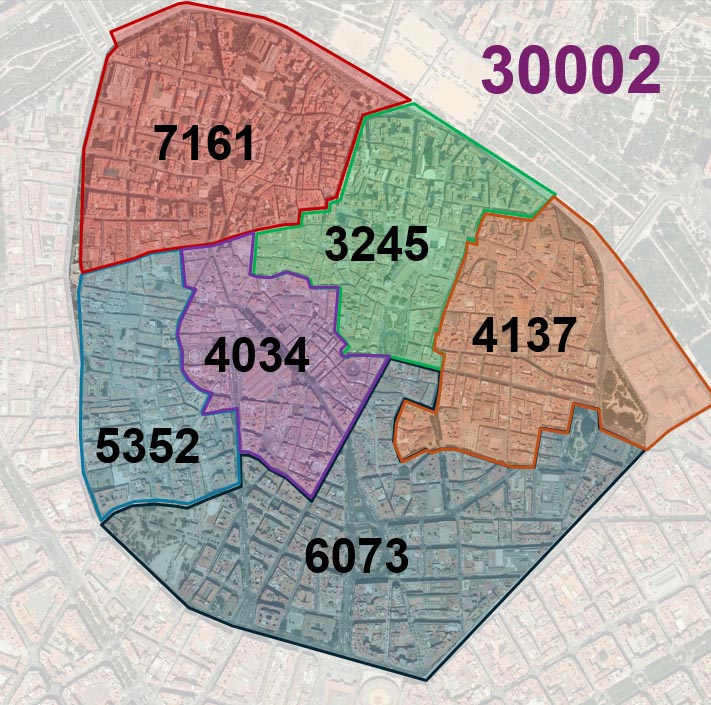
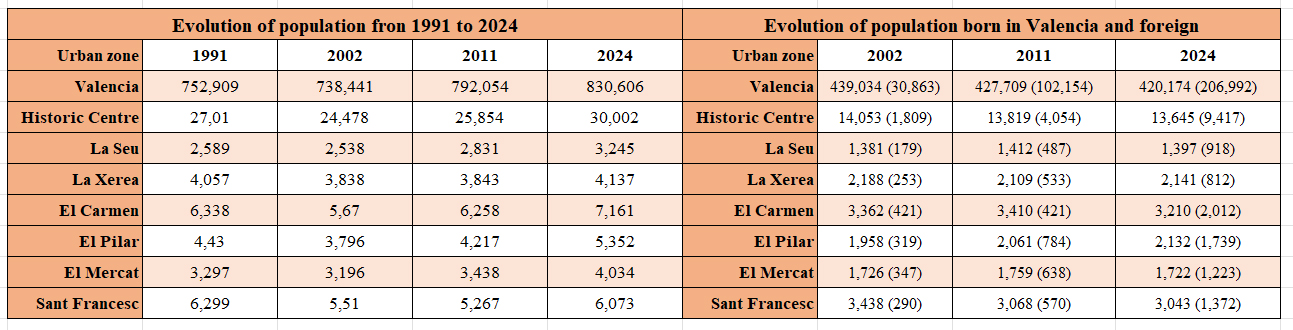
According to the most recent census, carried out in December 2024, Valencia has a population of 830,606 inhabitants (Table 1). The municipality covers a surface area of 55 km2, equivalent to a density of 15,000 inhab/km2, if the districts of Huerta Sur, Norte and Oeste are excluded. As these are the largest districts, with scattered housing, they would alter the interpretation of data for the city centre. The nucleus of the historic centre, with 30,002 inhabitants, has a slightly higher density, with 17,752 inhab/km2. Although there is no consensus on the advisable range for an optimum population density, it could be said to currently vary between 12,000 inhab/km2 and 35,000 hab/km2.
Moreover, the data analysed show that among the residents of the historic centre, 46% are Valencian. This represents an alarming decrease compared to the figures from 2002 (57%) and 2011 (53%). According to the tendency forecasts, considering these data (expanded in Table 2), in the year 2035 around 35% of residents in the historic centre will be Valencian unless this situation comes to halt. This is an alarming drop in autochthonous population, who in recent years have been driven out of their usual residence, in most cases due to the effects of touristification and the transformation of historic centres into multicultural commercial centres.
In recent decades the increase in the number of foreign residents in the city has been exponential. In 2002 the city had 738,441 residents, only 4% of them foreign. By 2011 (792,054 inhabitants) this proportion had increased three-fold, exceeding 12%, and in 2024 (830,606 inhabitants) foreign population accounted for 25%, also making up 30% (of the 30,002 inhabitants) in the historic centre (Table 2).
Housing vs. touristic flats
The 830,606 people living in the city account for a housing stock made up of 418,232 dwellings, of which almost 5% (19,453) can be found in the historic centre. Throughout the municipality over 20% of these dwellings lie empty or are second homes, and this figure increases to over 40% in the historic centre.
An INE census of accommodation for tourist use shows a total of 1,278 dwellings dedicated to tourist accommodation rentals, with a capacity for 5,128 people. These figures do not match those provided by Generalitat Valenciana, recording dwellings with official licences: 1,484 dwellings, capable of accommodating around 6,000 people in the historic centre. In neighbourhoods like El Mercat, tourist accommodation accounts for 18.3% of almost all housing stock, with a further 12.7% in La Seu, and almost 10% in El Carmen.

Effects on economy and commerce
According to a survey carried out by Exceltur in May 2022 in tourist neighbourhoods from six Spanish cities, including Valencia, 77.7% of residents in tourist neighbourhoods stated that accommodation for tourist use had increased the price of housing, while 68.4% reported that it had disturbed life in the neighbourhood to the point that usual residents were being driven out. In response to this phenomenon, many neighbourhood groups and collectives from the historic centre have organised protest movements, especially since 2017. With cries of “Ciutat Vella no está en venta” [Ciutat Vella is not for sale] they demand new strategies to fight touristification (Fioravanti, 2022). These initiatives are similar to others seen in Barcelona, Madrid, Paris, Berlin, Venice, San Francisco and Rio de Janeiro. As a result, local identity elements are lost and commercial spaces for residents are transformed into an uninspired offer of convenience and food stores geared towards tourism. The new Special Protection Plan for the Historic City Centre (PEP Ciutat Vella), which came into force in early 2020, offers a stable regulatory framework for the entire historic centre for the first time. As stated above, there is a catalogue of 49 historic commercial establishments known as ‘emblematic establishments’, some of which have been in operation for over 150 years. They were included in the catalogue either because their activity has been uninterrupted over generations, or because the premises have conserved the typology, original furniture or other heritage elements contemplated in its 49 fiches. It is alarming that almost half of these emblematic establishments have closed in the space of barely five years, despite being protected.

 ENACT 15 mC